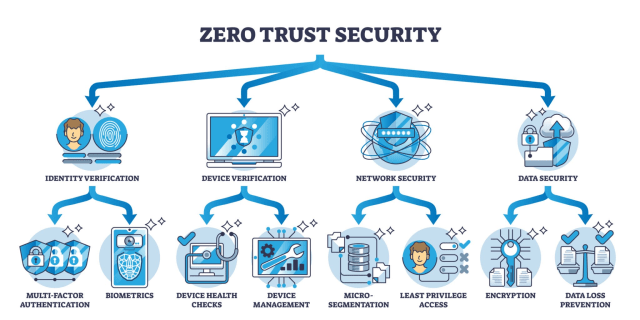
For decades, network security operated on a “castle-and-moat” philosophy: once you passed the perimeter firewall, everything inside the network was implicitly trusted. This model worked well when everyone was in a single office building. But in the age of hybrid work, cloud computing, and ubiquitous mobile devices, that internal trust has become the biggest vulnerability.
The solution is the security philosophy dominating the industry today: Zero Trust Architecture (ZTA). Its core principle is simple: Never trust, always verify.
What is Zero Trust?
Zero Trust assumes that every user, device, and application—whether it’s inside or outside the traditional network perimeter—is a potential threat. It dismantles the idea of a trusted internal network and requires continuous, granular verification for every single access request.
The Three Pillars of ZTA
1. Verification of Identity and Context
Access is never granted solely based on location. Before a user can access a sensitive file, the system rigorously checks:
- Who are you? Multi-factor authentication (MFA) is mandatory.
- What device are you using? The device must be verified, patched, and compliant with security policies.
- Where are you accessing from? The system checks geographic location and time of day for anomalies.
- Why do you need access? This confirms the context of the request (e.g., an accountant accessing financial data during business hours).
If any factor changes—say the user suddenly logs in from a suspicious country—access is immediately revoked or restricted.
2. Least Privilege Access (Micro-Segmentation)
In the old model, if a hacker gained access to one workstation, they could often move laterally across the entire network. ZTA stops this using Micro-Segmentation.
Instead of granting broad network access, the network is divided into tiny, isolated segments. Users are only given the precise access they need to perform their current task—a principle known as Least Privilege Access (LPA). For example, a marketing specialist might only be able to access the marketing file server, and that access is limited only to the specific duration required. This technique dramatically limits the damage a potential breach can cause, preventing threats from spreading.
3. Continuous Monitoring and Assessment
Zero Trust isn’t a one-time login; it’s an ongoing process. The security system continuously monitors user behavior and device health. If an employee’s machine starts sending out an unusually high volume of data (indicating potential malware), or if their access patterns suddenly deviate, the ZTA system will instantly flag the session for re-authentication or terminate it entirely. This adaptive security is crucial for catching subtle, prolonged attacks that traditional firewalls often miss.
Why ZTA is the New Normal
Zero Trust has become the mandated baseline for security, especially for organizations interacting with sensitive data or managing remote workforces. By eliminating implicit trust, ZTA provides a robust defense against modern threats like phishing, ransomware, and insider attacks. It’s the foundational philosophy that secures the future of cloud computing, dispersed data, and the digital workplace.
If your organization hasn’t fully embraced the Zero Trust philosophy, it’s not a matter of if you’ll be compromised, but when. The perimeter is dead—long live verification.
I hope these three detailed blog posts on Edge Computing, Post-Quantum Cryptography, and Zero Trust Architecture are exactly what you were looking for! Let me know if you have any editing requests.
Follow us to see more useful information, as well as to give us more motivation to update more useful information for you.


